Why a good result can lead to a cash crisis

Iiro
Christensen
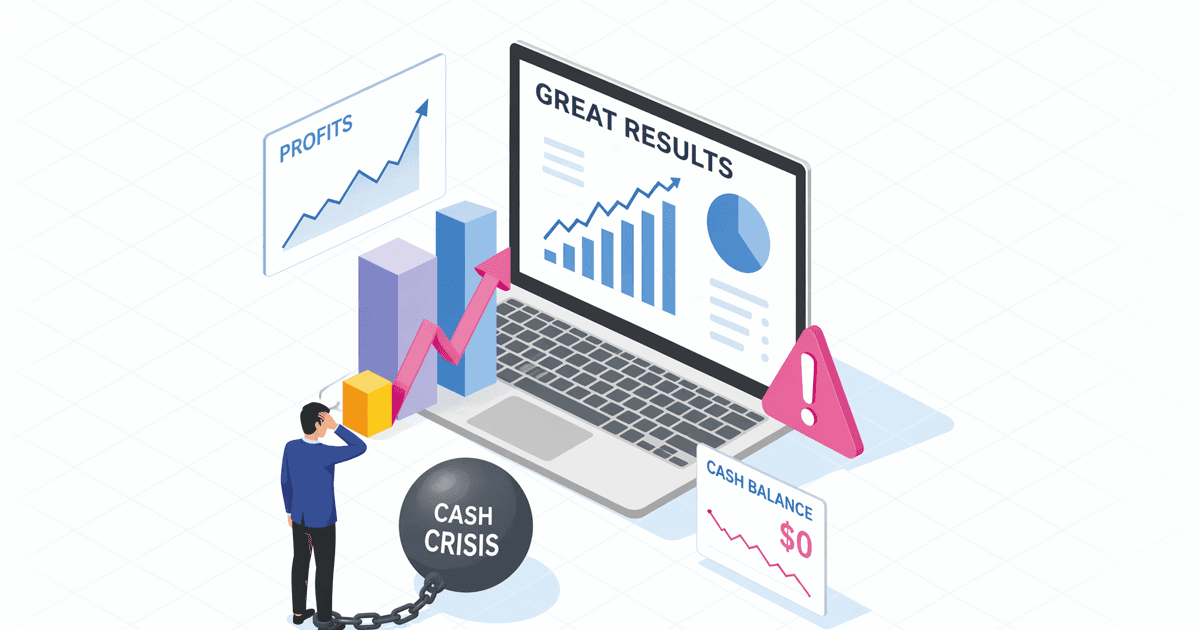
Even a profitable company can run into payment difficulties if management interprets financial data based on incorrect information. One common problem is that management focuses mainly on the company’s result and profitability, while neglecting to monitor cash flow. Some also confuse profit with cash flow.
In this text, we will go through what profit actually measures, where the difference with cash flow arises, and why the cash flow statement should be monitored alongside the income statement.
Profit does not tell the whole story about a company’s cash situation
The income statement describes business on an accrual basis (note: accounting is prepared on an accrual basis). This means that revenues and expenses are recorded for the period in which the work is performed or the product is delivered—not when the money actually moves between the company and the customer.
If a company delivers a project in December, the revenue appears in December’s result, even if the customer only pays the invoice in February. However, the cash appears in the company’s account only when the payment is received.
The cash flow statement, on the other hand, reflects actual cash movements. It shows when money comes into the account and when it leaves. A company may appear profitable based on its result and still be in a situation where cash is almost depleted.
When a company has long payment terms, accounts receivable often grow quickly. In such cases, a significant portion of the profit is only reflected in cash after a long delay. This increases the risk of misinterpretation and may lead the company to make harmful decisions.
The same phenomenon appears in inventories and accounts payable. As inventory grows, cash is tied up in goods sitting on shelves, even though they only affect profit when sold. Accounts payable work in the opposite way: long payment terms from suppliers temporarily improve cash flow, but tightening terms can quickly weaken it without affecting profit.
Investments and accounting distort the timing
Investments are another key reason for the difference. When a company makes a large purchase, cash leaves immediately. However, in the income statement, the impact is spread over time through depreciation.
Similarly, for example, product development costs can be capitalized on the balance sheet, meaning they do not immediately affect profit—even though the cash has already been spent.
In addition, value-added tax (VAT) can easily distort the cash view. A company’s account may contain significant sums that do not belong to the company but to the tax authority. In practice, the tax authority temporarily finances the company’s working capital, making the situation look better than it really is. However, this carries a risk if taxes are not separated in the cash flow statement.
Timing differences in salaries and holidays
There are also timing differences related to salaries. Salaries are paid on a certain schedule, but related taxes and social costs are paid later. This can temporarily improve cash flow, but the effect reverses quickly if business slows down.
Another practical example is holiday pay. The expense accumulates evenly each month, but the cash is often paid within a short period, for example in August. The company’s result may look stable, but cash shows a sudden drop.
Profit alone is not enough for management
The income statement and balance sheet alone are not sufficient management tools. The cash flow statement is essential when assessing liquidity. It makes visible when money actually moves and where risks arise. It is also important to break down items such as VAT so their impact becomes clear.
It is normal for a company to seek financing even when the result is good. The reasons are usually the same: accounts receivable are growing, expenses have already been paid from cash but are not yet reflected in the result, and upcoming payments have not been anticipated.
From a management perspective, the key question is not only whether the business is profitable, but whether there is enough cash in all situations. Without active cash flow monitoring, this question cannot be answered reliably.